

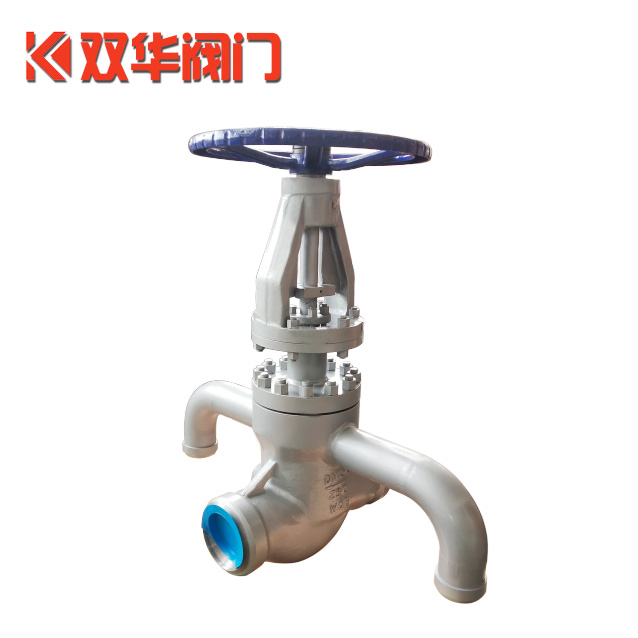
The high-pressure heater inlet valve is installed at the inlet of the high-pressure heater. When the high-pressure heater malfunctions and the water level exceeds the allowable level, the water supply is urgently switched to the bypass to ensure the safe disconnection of the high-pressure heater, thereby protecting it.
Main model specifications of high-pressure inlet valve: Model: J762Y, J962Y, J963Y, J764Y, J964Y Nominal diameter: DN 175, 225, 275, 300mm Nominal pressure: PN 20.0, 25.0, 30.0mpa1. Fully hydraulic control system: Fast action, with a switching time of up to 2S.
2. Alternatively, electric inlet and outlet valves can be chosen: although the operation time is slightly longer, it is possible to omit two pneumatic quick-opening valves, simplifying the system design.
3. The hydraulic cylinder is equipped with a damping cone to protect the system pipeline and valve seat from impact.
4. The valve body is of Z-type or angle-type, and the bypass direction can be adjusted within a range of 180 degrees.
5. The valve body is either cast or integrally forged, with materials including WCB, A105, or WB36 (15NiCuMoNb5). Among them, the WB36 valve body is more suitable for use in supercritical and higher pressure units.
Main parts and materials of the high-pressure heater inlet valve: valve body: high-quality carbon steel, valve cover: high-quality carbon steel, valve disc: hard alloy, valve seat: hard alloy, valve stem: chromium-molybdenum steel, sealing ring: reinforced flexible graphite, packing: flexible graphite, bracket: carbon steel. The high-pressure heater integrated valve is an automatic protection device equipped for high-pressure heaters. It ensures that in case of anomalies such as leakage in the high-pressure heater piping system or jamming of the drain adjustment valve, the valve automatically closes to block water flow to the high-pressure heater piping system and opens the bypass for water flow. Since the high-pressure heater is designed to cut off water supply, a set of water-side protection valves is designed. The term "high-pressure heater integrated valve" refers to a set of valves, which can be divided into inlet integrated valves and outlet integrated valves. The high-pressure heater inlet integrated valve is also commonly known as the water supply three-way valve. Three-way valves are divided into electric and hydraulic types, and are most commonly used in units with a capacity of over 300,000. This is because the high-pressure heater water-side outlet valves are mostly designed as electric gate valves. The high-pressure heater integrated valves are all hydraulic valves powered by water supply. When needed, the integrated valve is closed to cut off water supply, and water flows through the small bypass pipe (two pipes) to the outlet integrated valve (also known as check valve). The check valve closes under the action of water coming from the small bypass, while water flows through the check valve to the boiler, avoiding water cut-off in the boiler and protecting the high-pressure heater. The design of this valve is unique, with an upper valve seat and a lower valve seat. When the valve is opened and water enters the high-pressure heater, the valve core contacts and seals with the upper valve seat to ensure that water does not flow through the small bypass; when the valve is closed and water flows through the small bypass into the boiler, the valve core contacts and seals with the lower valve seat to ensure that the high-pressure heater can be disconnected and maintained.
The high-pressure heater protection valve produced by our company is used in the high-pressure heater feedwater protection system. When the high-pressure heater fails or is tripped due to other reasons, the valve quickly cuts off the feedwater to the high-pressure heater, causing it to disengage. The feedwater then enters the boiler through a bypass, thus protecting the high-pressure heater and ensuring the normal operation of the unit. Our high-pressure heater protection valve is divided into three types according to different unit and system requirements: 1. Electric three-way high-pressure heater combined protection valve (inlet valve) - This valve features good medium flow lines, low flow resistance, and reliable performance. It is a three-way valve, with feedwater introduced from the side inlet, flowing downwards into the high-pressure heater through the outlet, and the other outlet connected to the bypass pipeline. The valve has two sealing surfaces, both above and below. During normal operation of the high-pressure heater, the valve is open, with the valve disc moving up to contact the upper sealing surface and the bypass is cut off. When the high-pressure heater fails or needs to be tripped due to other reasons, the valve disc moves down, closing the valve. Feedwater then enters the boiler directly through the bypass pipeline via the other outlet, bypassing the high-pressure heater, thus disengaging it. This valve has two valve seats, with the lower seat directly welded to the valve body and the upper seat sealed to the valve body with a sealing ring, ensuring no leakage during normal operation and long-term service. The sealing surfaces are overlayed with Stellite alloy, which is wear-resistant, scratch-resistant, and has a long service life. The electric actuator is sourced from Limitorque, Siemens, or imported high-speed, high-quality electric actuators, providing reliable and stable performance. The valve stem adopts a special design process, ensuring a switching time of 30 seconds. This valve is paired with an outlet valve (electric gate valve) to ensure the safe operation of the high-pressure heater.
2. Hydraulic four-way high-pressure heater interconnected protection valve (inlet valve) This valve is a hydraulic four-way valve, with water inlet from the side and outlet downwards into the high-pressure heater. There are two outlets above the valve connected to the bypass pipeline. The valve has two sealing surfaces, both above and below. During normal operation of the high-pressure heater, the valve automatically opens due to the pressure difference acting on the valve disc section, and the valve disc moves up to contact the upper seal, cutting off the bypass. When the high-pressure heater experiences an accident, such as a pipe rupture, causing the water level to exceed the allowable level, the water level signal activates the quick-opening and closing valve through an electrical device. Condensate water enters the upper part of the hydraulic cylinder, pushing the piston, causing the valve disc to move down and quickly close the valve. Water then enters the boiler directly through the two bypass pipelines above, disconnecting the high-pressure heater and protecting the safe operation of the unit. This valve has two valve seats, with the sealing surfaces overlay welded with Stellite alloy. The lower valve seat is directly welded to the valve body, while the upper valve seat and valve body adopt a dual-channel self-sealing structure to ensure normal operation and long-term leak-free performance of the valve. The valve operates within 2 seconds. This valve is paired with an outlet valve (manual check valve) to ensure the safe operation of the high-pressure heater. According to system requirements, this four-way valve can also be electrically controlled, with accident signal feedback, driving the valve action through the electric device on the top of the valve to achieve the function of protecting the high-pressure heater. 3. High-pressure heater protection achieved through the combination of three electric valves: During normal system operation, the bypass valve is closed, and the inlet and outlet valves of the high-pressure heater are opened, allowing water to pass through the high-pressure heater to the boiler. When the high-pressure heater fails, the bypass valve is opened and the inlet and outlet valves of the high-pressure heater are closed, disconnecting the high-pressure heater and allowing water to directly enter the boiler through the bypass, thus completing the protection of the high-pressure heater and ensuring the normal operation of the entire unit.

